Posts

Mavericks don't sell cameras. Quality does.

Image
Say you're a big company in the camera biz. Your brand's grown a little dusty, and competition heats up. If you're like a few companies, you realize where you've gone off-track. You switch from building awkward, robot-looking cameras, and try to inject a little color, ruggedness and quality into your products. Here I'm thinking of Panasonic, which probably manufactures many digital cameras for other brands, but chose to beef up its own cameras, too. They made water-proof cameras that actually take nice photos. They use Leica lenses in almost every camera. And they often lead the way in innovation, which results in image quality -- which is all that really matters in a camera. What Panasonic didn't do: They didn't sink skillions in a U.S.-only sponsorship for rich white men. They didn't decide to cheapen every camera model in their line with chrome paint and plastic bodies that look like metal, but aren't. They didn't let a maverick marketing VP...

Target Photo CD -- is it just capacity?

Image
Over in Target-Land, I asked the photo department "team member" the difference between a Target Photo CD and a Kodak Picture CD. She replied: "The Kodak CD holds more pictures." Say what? Unless the Kodak CD is actually a DVD, it holds the same 800 MB as every other CD on the planet. Less, perhaps, because Kodak's CD's usually contain viewer software and a file to download and install Kodak's EasyShare photo-editing software. Sure, I could be mistaken. But if there's no premium aspect to the Kodak CD, why is there a $1.50 price premium over the Target CD? Target, are you listening?

POS, or at the bar

Image
No, not what you're thinking. Here, "POS" abbreviates "point of sale." As in, where you go to buy cameras. I hate the camera bar. Or, as I've described it elsewhere, the "camera anchorage." That semi-circular tier of cameras on display, where every camera is attached to a weighty metal anchor which, in turn, is cabled to the display. This is the worst way to experience a camera. You can't tell how a camera feels in your hands if it's bolted to an anchor. You can't tell if it's lightweight or too heavy. And you probably can't tell whether its tripod socket is in a centered position or off to one side. I want that experience. More to the point: I want to power up the camera and see if it works as I expect. That means the power connector from the camera bar has to operate. Which it seldom does. Target, Walmart, BJ's and Best Buy all have a variant of the camera anchorage, and every one I've experienced has electrical issues...

Reviewing the reviewers

Image
Here's a quick guide to getting information about any camera you're considering: If you understand f-stops, apertures, and aspect ratios, web sites such as dpreview.com, CNET.com and dcresource.com are good online resources. Between the writers' in-depth reviews and the opinions you'll find in the online forums, you'll trip over more details than you need. Do note that dpreview.com has lately acquired a certain ambivalence in its professional reviews, and rarely comes out to say it dislikes a camera. Maybe this has something to do with most digital cameras sharing the same lenses and sensors, to some degree. I also recommend Steve's Digicams and imaging-resource.com, although both tend to get wrapped up in techno-speak. If I want to watch Star Trek, I'll watch Star Trek. If all those tech terms frustrate you, head on over to amazon.com. Almost every camera has user reviews to read. These are real-world people, for the mostpart, who don't dwell on pixel d...

How to buy this camera

Image
I'm going to tell you how to choose a digital camera -- what to look for, and what to ignore. Please pay attention. Many people ask me which camera they should buy. It's easy to suggest one sold by my employer, but different people have different photographic needs. And an $80, 3x zoom camera with a plastic lens might not make you happy if you want to shoot wildlife that's 100 feet away. This isn't to say my employer makes inadequate cameras; it's merely that one size doesn't fit all. I'm currently using a K odak Z950 , which delivers fine performance, feels great in my hands, and costs around $150. First, the items you can ignore: IGNORE "megapixels". Really. If it has more than 8 megapixels, it'll give you the photos you want. If you need a 14-megapixel camera, you'd better be shooting images to display on billboards, because you'll seldom need a 14-MP file. IGNORE "fits in a pocket." Ninety percent of today's cameras fi...

Yeah, they're dead

Image
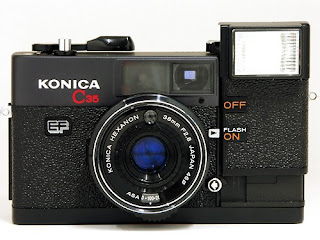
Spent some time this weekend sorting out my collection of 35mm film cameras. Way too many film cameras. And now there are a couple in the trash can. I'm a fan of 1970's era rangefinders, cameras that allowed you to hold the camera to your eye, look through a viewfinder, and focus on your subject. Some even allowed you to control the aperture or shutter speed. Olympus, Minolta and Canon made the best of these. Konica made some wonderful cameras, but later jobbed out the manufacturing to a company called Cosina. Then Chinon got involved. Ultimately, the move to auto-focus film cameras doomed the rangefinders. Not to mention the corroded electronics. Most of these cameras used mercury batteries, which seem to cause some degradation in circuit contacts. The camera above is a Konica C35EF camera. Happens to be the very first thing Dick Kidder stuck in my hands when I started my first newspaper job. So I'm sorta fond of them. This afternoon, I pitched two Konica C35EF cameras wit...

How to sell cameras on Craigslist

Here's a short but handy checklist to help you sell cameras on Craigslist: Don't simply say "Nikon digital camera." Give a model number: Coolpix 5400, L20, whatever it says on the camera body. Get the brand right. Shoppers often search by brand name. There's no "Cybersnap" or "Olympis" brand in digital cameras, but there are a Cybershot and an Olympus. Again, it's probably spelled correctly on the camera. Write a better headline than "Digital Camera 12 Megapixels." The difference between a camera made by Kodak or Polaroid is striking. Again, brand matters. Don't fill your ad with meaningless specs borrowed from a web page. Instead, be sure to tell us whether all the camera's functions work, if the LCD screen is cracked, and whether the essential accessories (battery, charger, connector cord, manual, etc.) are included. Show a photo of the camera. Don't blow this off! If you're selling your only camera, set the cam...